Blog
Terra Australis Incognita
By Luciano Walter
When the world was still a mystery of horizons waiting to be unmasked, the Greeks dreamed of far-off, untamed frontiers. Reasoning from principles of symmetry, they believed that the vast landmasses of the north must have a counterpart in the southern hemisphere. Antarctica was a premonition millennia before we first glimpsed the landscape of its everlasting solitude. A land bearing no culture’s face.
Though it was the last continent to be trodden by man, for centuries before its discovery it already inhabited maps and the fevered imaginations of explorers.
Men go out into the waste places of the world for various reasons. Some are actuated simply by a love of adventure, some have a keen thirst for scientific knowledge, and others again are drawn away from the trodden paths by the “lure of little voices,” the mysterious fascination of the unknown.
So Shackleton begins, in The Heart of the Antarctic, to recount the trials of one of his celebrated expeditions to the white continent. Of course, in the first decade of the twentieth century, he could not have foreseen that one day we would come by the thousand to those remote solitudes. And that we would do so all but certain of returning home safe and sound.
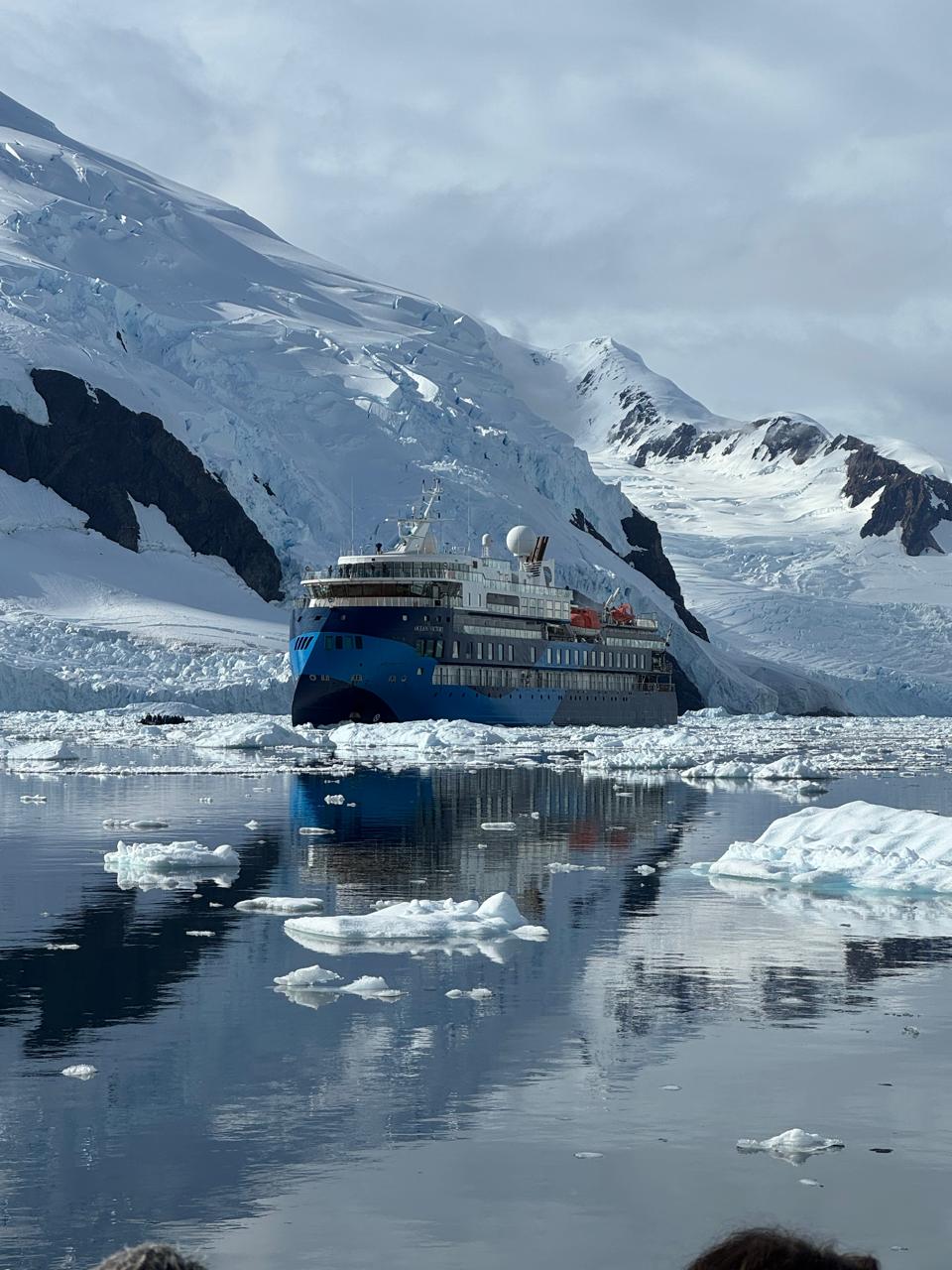
Tourism in Antarctica takes place in the austral summer, the only time when the coldest, windiest, most isolated place on Earth grants us a fleeting truce. Yet to think we have conquered nature’s last bastion because we visit it during this window of a few months would be like fancying ourselves Poseidon for having surfed a wave.
Today’s polar cruise ships, with their reinforced hulls, ever safer and more comfortable, bear little resemblance to the fabled vessels of the Heroic Age of polar exploration: Discovery, Nimrod, Endurance, or the corvette ARA Uruguay. Perhaps only the awe of those aboard any voyage that has ventured beyond the storm-lashed warning of the Drake Passage remains the same, then as now. For all the comforts and assurances of modern Antarctic expeditions, those extreme latitudes still test a traveller’s mettle.
In 2015 I made my maiden voyage to the last continent, which is also the sixth or the seventh, depending on where one went to school. The multicoloured rings of the Olympic flag represent the continents inhabited by Homo sapiens sapiens: five. But there is no general agreement on the matter. Some divide America into two great expanses of land; others count it as one. Whatever its place in the reckoning—for from Pangaea to this jigsaw puzzle drifting at the mercy of the oceans, the universe has cared little for the niceties of our nomenclature—Antarctica has always been, for me, a deep and distant call.
In primary school, I would look up from my desk at the white blotch on the underside of the globe, one of those schoolroom globes in pale blue that always threatened to topple from the teacher’s desk as we shoved one another or dodged flying chalk. The Antarctic Peninsula was a frozen, suffering tentacle reaching towards Patagonia as though in a gesture of provocation.
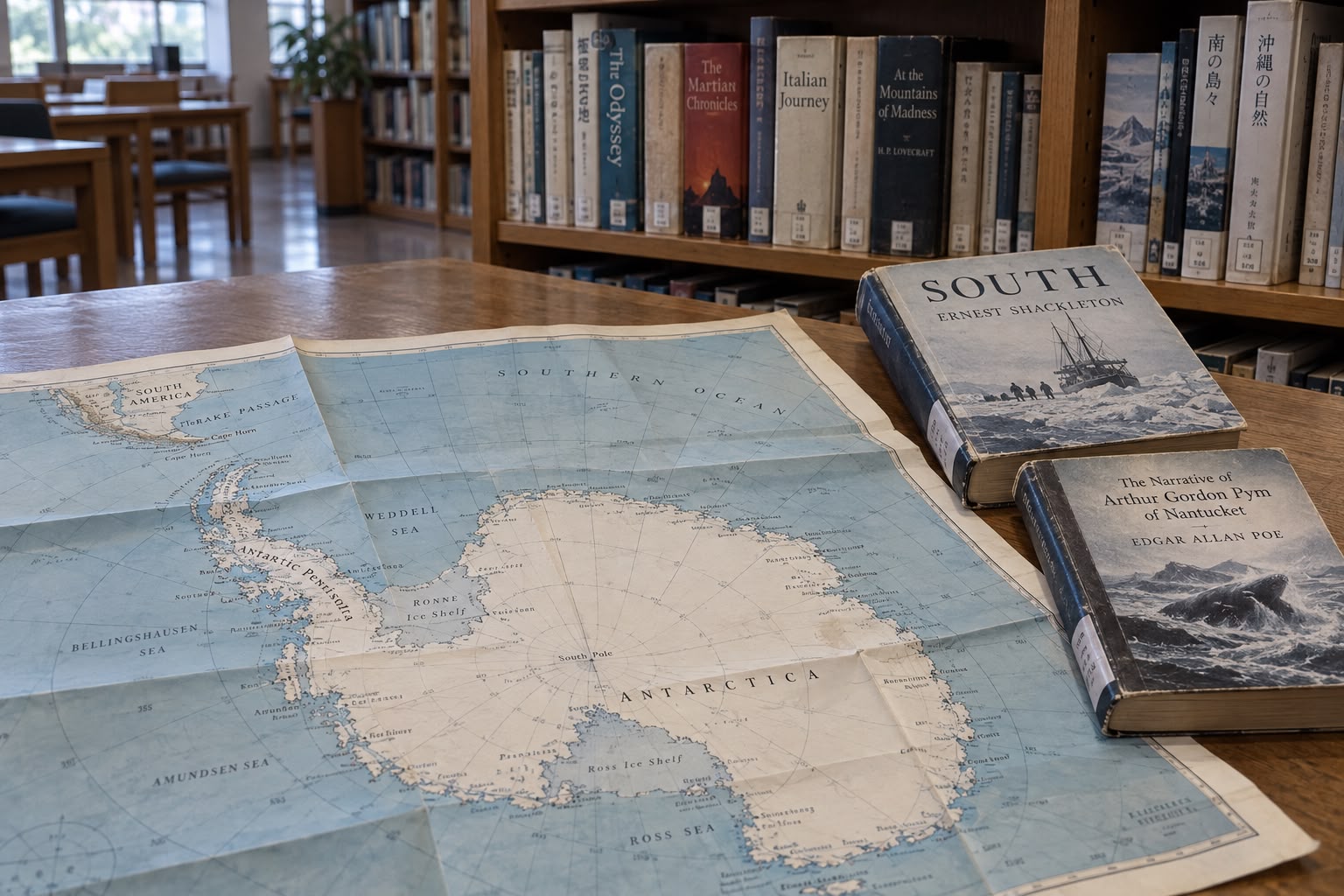
At thirty I sailed from Ushuaia towards that cartographic memory, full of fantasies and fears fed by Lovecraft’s At the Mountains of Madness. And by an oceanographer uncle who had taken part in three scientific campaigns at Marambio Base. Each time he returned, he brought me photographs and stories that distilled cold and wonder.
It took almost two days at sea to negotiate the nemesis of delicate stomachs, the Drake Passage. Being of that unseaworthy persuasion myself, I spent much of the time on deck, drowsy with dimenhydrinate. Outside, the waves gave my eyes a point of reference, and the salt air did me good; inside the cabin, the motion sent me stumbling and retching.
Behind the greyish veil rising from my cigar, the sea takes on a ghostly cast. Water everywhere, no land in sight: a strangeness impossible to anticipate. To find oneself at the mercy of nature’s whims is a mystical revelation. It hits. It pummels. I find it incredible that this place was once traversed by wooden sailing ships, without the modern weather and navigational instruments that temper the terror of venturing into the ocean’s salt enigma.
The truth is that I had already attempted the odyssey of crossing the deep leagues that set an abyss between Tierra del Fuego and Antarctica. On that occasion we had to turn back to the port of Ushuaia barely past the latitude of Cape Horn. The reason: Matsumoto.
The forecast twelve-metre waves appeared once we had left the shelter of the Beagle Channel, battering the passengers’ spirits without mercy. It is common, in extreme situations, to reconsider one’s life, to feel that one is not master of one’s own destiny. And in truth, when are we? Inside the floating cocktail shaker a ship becomes when the sea warns it has strayed too far from shore, the awareness of finitude is infinite. The announcement over the cabin loudspeaker tore me from these existential tirades. I felt anger. Joy, too. We were going back to Ushuaia.
Mr Matsumoto sat beside me at the captain’s welcome dinner the night before we sailed. A native of Okinawa, he had saved all his life for the journey to the end of the world. An obsession inherited from the municipal library, where someone had been rash enough to leave certain books within reach of his curiosity. A particular set of shelves held the exploits of our wandering kind. The Travels of Egeria; the travels of Marco Polo, and Gulliver’s too; The Odyssey; Goethe’s Italian Journey, and Verne’s Journey to the Centre of the Earth; The Martian Chronicles, and chronicles of other planets, such as B-612. But as the old Japanese man told me, a course of squall and tempest had been charted for him when, at just eight years old, he borrowed two books from that dangerous section of the library: Poe’s The Narrative of Arthur Gordon Pym of Nantucket. And Shackleton’s South. From that moment on, the compass of his longing pointed to the far south.
Life, which has plans of its own, had seen to it that the old man never left his little island in the Okinawa archipelago. At eighty-four he arrived in Ushuaia, the southernmost city in the world. It was his first journey. The dreamed-of one. The most fervently desired. Worn and stooped as he was, some renewed force seemed to urge him to speak. His measured, neutral English, surely acquired in the library, had the hypnotic effect of fine oratory. While we waited for dessert, he took out his Sony digital camera, a relic that must have been more than twenty years old. He began showing me photographs of photographs: magazines, drawings, newspaper clippings. A veritable press archive in his pocket. As if the wretched image quality were not enough, some were in black and white. There were even photographs of entire articles; the old man zoomed in to read me a passage. This ship was the first one to take tourists to Antarctica, he said, pointing to the magnified bow of a corvette called La Zelée. He told me how much he feared that the obsession of so many years would turn out to be his own Ithaca. What if it were a barren place, devoid of mystique, that had acted as a magnet all my life so that one day I might leave Okinawa? I told him I was sure he would love it. He gave me a smile at half-mast.
As we approached the entrance to the channel, the huge waves were behind us. We were still several hours from Ushuaia, and I fell asleep. In the morning the loudspeakers, by then heralds of failure, blared invitations for the passengers to disembark. On my way out I came across a member of the crew and asked whether there had been some problem with the storm. I had assumed that was why we had abandoned the voyage. He looked at me without looking at me and said, no; someone has disappeared.
Weeks later, the news appeared in several national newspapers. A sailing boat had found a suitcase floating out at sea. Tied to its handle was a rope. When the sailors pulled on it, they felt a weight at the other end. Later it emerged that the old traveller had been gravely ill. He had sold his house to reach the antipodes of the Land of the Rising Sun, in search of the adventures lived by the heroes of his books.
During my eventual crossing of the Passage, two years after Matsumoto’s thwarted voyage, I attended several lectures in the Sea Spirit’s conference lounge. The various speakers used a screen to accompany their talks with PowerPoint slides. After dinner, we listened to the historian. In the full flow of his discourse, after a theatrical pause, he let the word fall: scurvy. Instinctively, I slipped my hand into my parka pocket and stroked the orange I had picked up in passing from a table centrepiece. I knew we would never fully understand what those first expeditions had been.
I suppose it is time to speak of the long-awaited arrival, when at last we reached our destination. And now I understand the reason for so much preamble. How to describe the journey to Antarctica. Is it even possible? When it is new each time one sets eyes on the elusive geography of that farthest edge. When what happens there in a single second far exceeds Shakespeare’s pen. When now, as I write these lines in my study, I look at the equator’s bowed waist, flattened on the framed world map, and see above it the vast expanses of land with borders cauterised by fire; below, the countries beginning to come apart like the tatters of a colossal map drawn to actual scale. And farther down, deep in the south, where the impossible latitudes lie, the frozen, suffering tentacle beckoning me back.
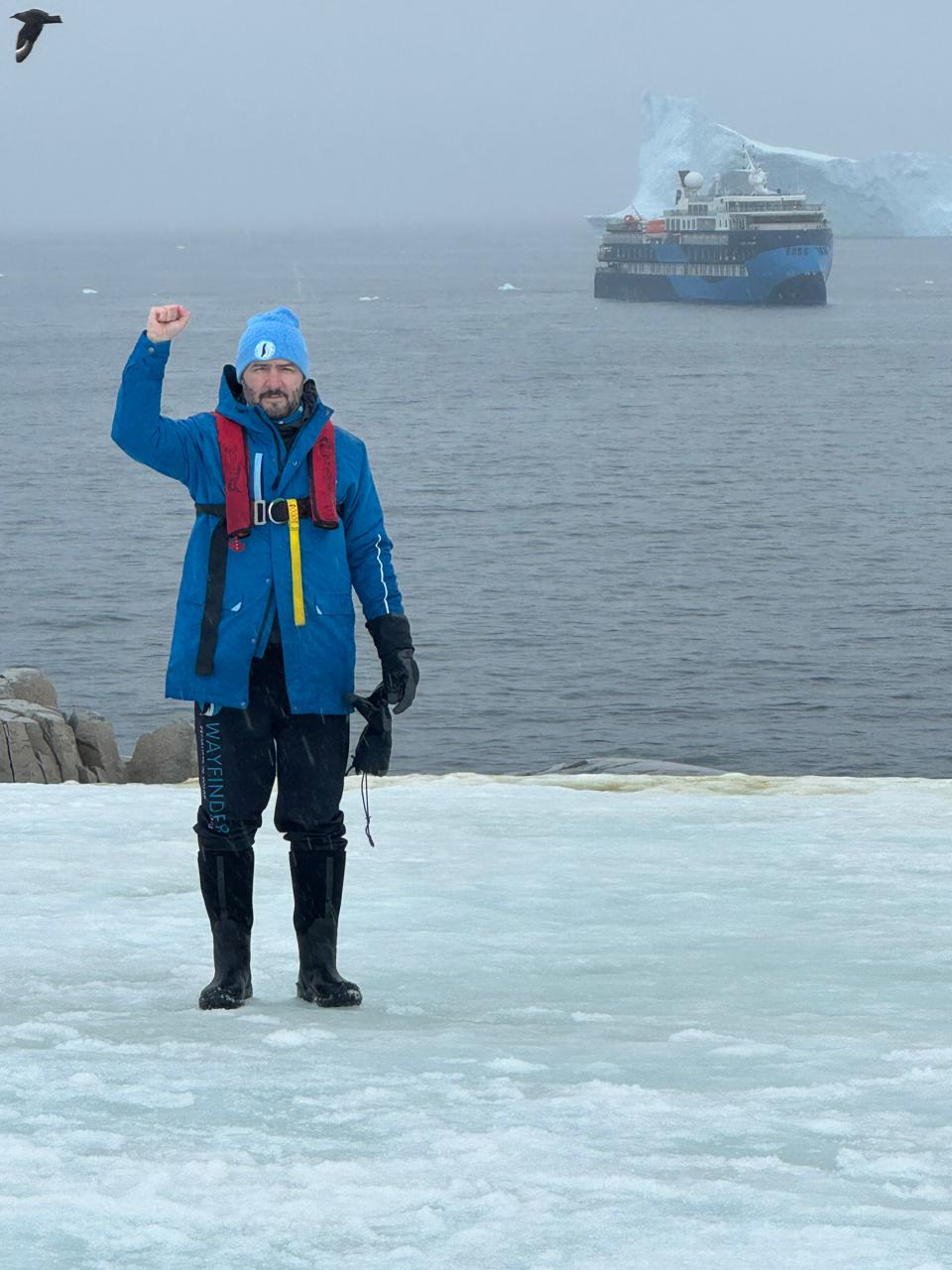
Luciano Walter is the founder and partner of Wayfinders, specializing in travel to Antarctica and the polar regions. Born in Patagonia and based in Buenos Aires, he studied Tourism at Universidad del Salvador. His work brings together a passion for polar travel, exploration, and storytelling. A published writer and poet, he is the author of Breve historia de la civilización (Südpol Editorial).